
Saudi Arabia's Industrial Pulse
What the IPI print tells us, and what it doesn't

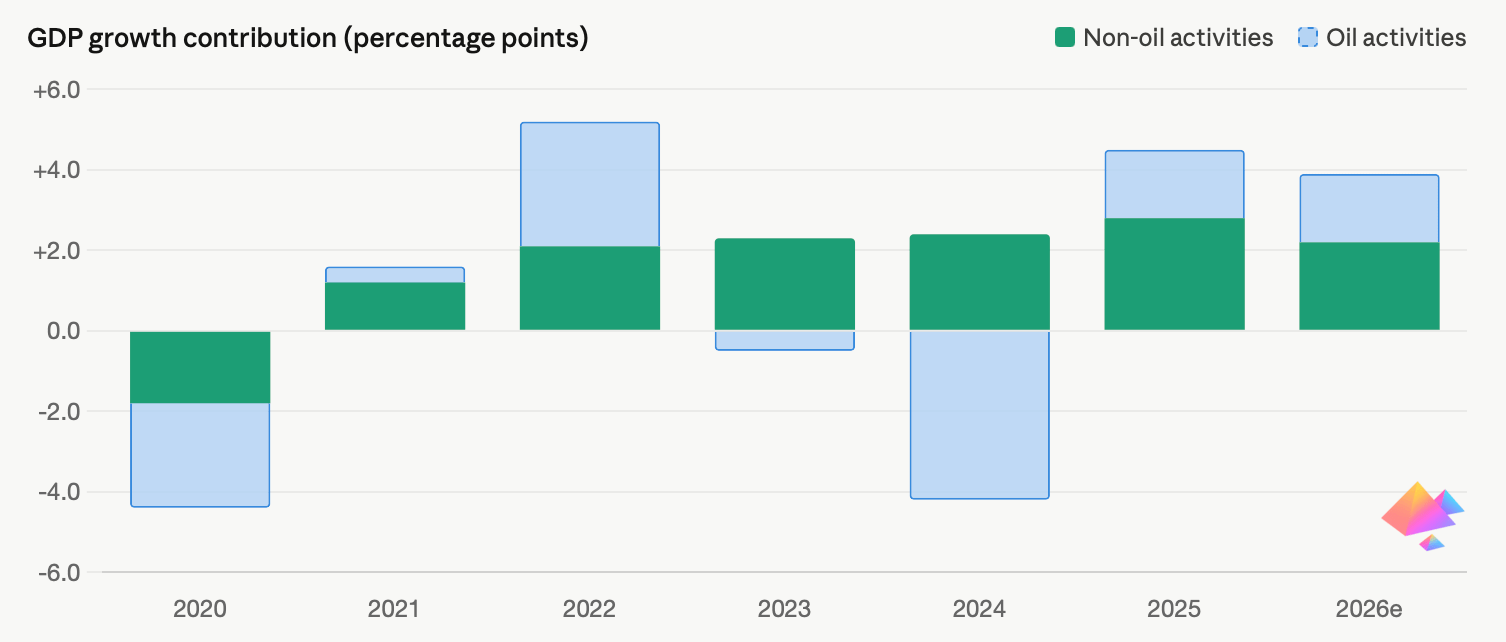
The Kingdom’s Industrial Production Index (“IPI”) rose 5.1% year-on-year in the latest release, with mining up 5.8% and chemicals surging 9.3%. Coming on top of a Q1 2026 GDP print in which non-oil activities contributed 1.7 percentage points to growth, the data point lands as more than a routine statistics release. It is the clearest quantitative signal yet that Saudi Arabia’s supply-side bets are starting to convert capex into output.
But a single data point does not make a structural shift. Understanding what is actually driving Saudi growth - and how durable it is - requires stepping back from any one release and reading several threads at once.
Three Engines, Not One
The story of Saudi non-oil growth in 2024–2026 is best understood as three overlapping engines firing with different degrees of autonomy.
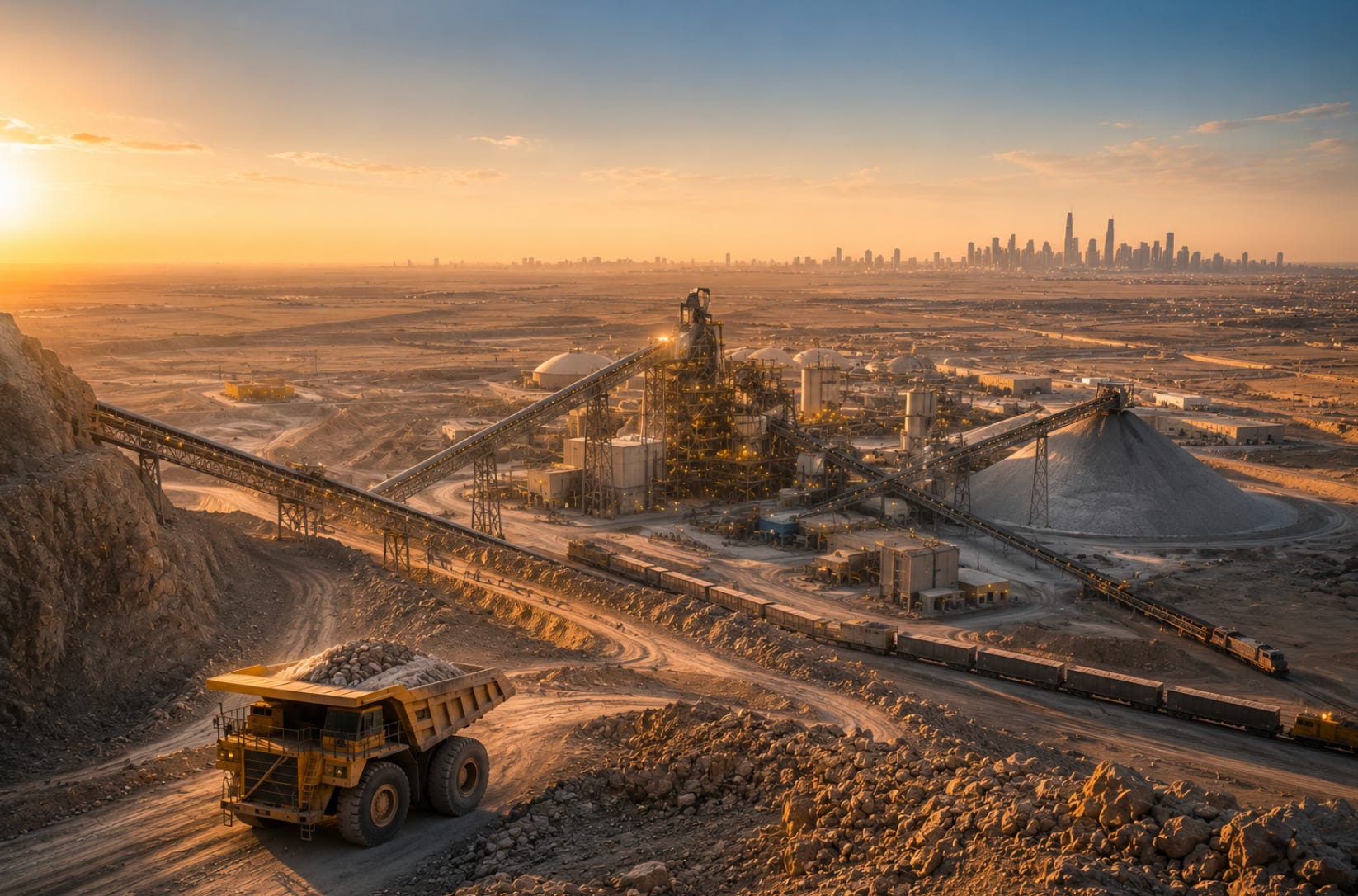
The industrial and mining engine is the newest. The IPI acceleration reflects years of upstream investment in mining infrastructure, chemical processing capacity, and manufacturing localisation. Saudi Arabia controls roughly 25% of global phosphate reserves and is moving aggressively to capture value-added processing rather than exporting raw materials. The 9.3% jump in chemicals is not noise - it reflects deliberate capacity build-out that has been in the pipeline since 2021.
The consumption and services engine is the most mature. Non-oil GDP grew 4.9% in 2025, with wholesale and retail trade up 6.2% and financial services up 6.1%. The Kingdom welcomed 122 million visitors in 2025, having surpassed its original 100-million tourism target seven years ahead of schedule. Umrah performers from outside the Kingdom exceeded 18 million, compared to 6.2 million in 2016. A young, employed, increasingly mobile population is spending, and the data confirms it.
The labour market engine may be the most structurally significant. Saudi national unemployment fell to 7.2% in Q4 2025, down from 12.3% in 2016, prompting Riyadh to revise its 2030 target downward from 7% to 5%. More than 222,000 citizens secured employment through Human Resources Development Fund programmes last year alone. Female labour participation has reached 35%, roughly doubling over the decade. An economy that can deploy its own labour productively is building a demand base that does not depend solely on government transfers.
The Number That Matters Most
Non-oil activities now account for 55% of real GDP - the Vision 2030 diversification metric that everything else is measured against. The private sector contributes 51% of GDP, up from 40% at baseline. These are not rounding errors. They represent a genuine structural shift in the composition of the economy, even if the pace of change was partly made possible by oil-funded public investment.
Total GDP reached USD 1.27 trillion in 2025, growing 4.5% in real terms - the strongest print since the pre-OPEC+ cut cycle. The IMF projects 3.9–4.5% growth for 2026, driven by a combination of faster non-oil momentum and the gradual unwinding of voluntary production cuts that held Saudi crude output at 9 million barrels per day through much of 2024.
The Risk Layer
Institutional investors and risk practitioners reading these numbers should resist two temptations, the reflex to dismiss Vision 2030 as a mirage, and the equally lazy reflex to treat it as a done deal.
The honest picture contains a significant dependency that the headline numbers obscure. The IMF estimates that a 10% change in oil prices corresponds to roughly a 0.5% change in non-oil sector GDP, mediated through fiscal transfers, PIF deployment, and consumer confidence. The Saudi fiscal break-even sits at approximately USD 94 per barrel for 2025, falling to around USD 88 in 2026. The 2026 budget already plans a deficit of 3.3% of GDP. At current oil prices, the fiscal cushion that funded non-oil growth through 2021–2024 is thinning.
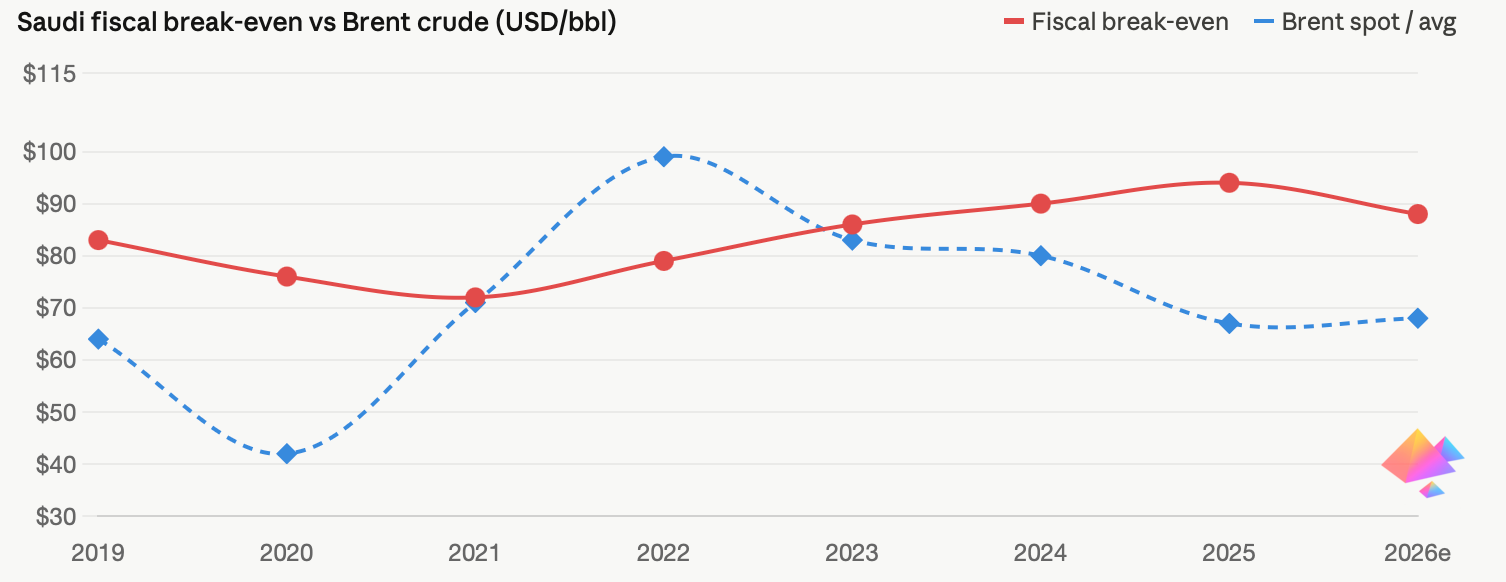
Put plainly: the IPI acceleration and the non-oil GDP figures are real. The question is whether the private sector has reached sufficient scale and internal momentum to sustain them at lower levels of government stimulus. The evidence from 2025 suggests it is getting close - but is not there yet.
What to Watch
Three indicators will tell the story over the next 18 months more reliably than any single IPI print.
First, the non-oil primary fiscal balance. If Riyadh can shrink the gap between what it spends on non-oil activity and what it collects in non-oil revenue, the growth story becomes structurally credible. The IMF wants to see an additional 3.3% of non-oil GDP generated over 2026–2030, mainly through non-oil revenue mobilisation.
Second, FDI quality rather than quantity. FDI stock grew 119% since 2017 to SAR 293 billion in 2025. But the composition matters - patient manufacturing and technology capital is different from project-tied construction inflows that leave when the giga-project phase winds down.
Third, SME contribution to GDP. Over 1.7 million small and medium enterprises now employ 8.8 million people and contribute 22.9% of GDP. If that number rises toward 35% by 2030, it would signal that the private sector is generating organic activity, not just absorbing public contracts.
The IPI release is a data point worth watching. The broader picture it sits within is a structural transformation that is further advanced than most external analysts acknowledge and more dependent on oil-funded momentum than the headline diversification metrics suggest.
Both things are true at once. That tension is precisely what makes Saudi Arabia one of the more analytically interesting macro stories in the GCC today.